Two AI titans, one decision. We put OpenAI’s GPT-5.6 Sol and Anthropic’s Claude Fable 5 head-to-head across 20+ benchmarks, real coding tests, writing tasks, and pricing analysis to help you choose the right model for your workflow.
The AI landscape in mid-2026 is dominated by two names: OpenAI’s ChatGPT (powered by GPT-5.6 Sol) and Anthropic’s Claude (Fable 5). Both are frontier models with million-token context windows, multimodal capabilities, and claims of state-of-the-art performance. But they are not interchangeable.
I’ve spent the last week running identical prompts through both models, digging through official benchmark data from OpenAI and Anthropic, and analyzing third-party evaluations from organizations like SWE-Bench, LiveCodeBench, and Menlo Ventures. The result is this comprehensive comparison—no fluff, no marketing spin, just the data and my honest observations.
Here’s the short version: ChatGPT is cheaper, faster, and better for general-purpose tasks. Claude is more thorough, safer for complex coding workflows, and superior at handling long-context projects. But the full picture is more nuanced, and the right choice depends entirely on what you’re building.
Executive Summary
| Dimension | ChatGPT (GPT-5.6 Sol) | Claude (Fable 5) | Winner |
|---|---|---|---|
| Reasoning | Agents’ Last Exam: 52.7% | Agents’ Last Exam: 45.2% | ChatGPT |
| Coding Quality | SWE-Bench Pro: 64.6% | SWE-Bench Pro: 80.3% | Claude |
| Interactive Coding | Terminal-Bench: 88.8% (Ultra: 91.9%) | Terminal-Bench: 83.1% | ChatGPT |
| Science Q&A | GPQA: 94.6% | GPQA: 94.3% | ChatGPT |
| Web Browsing | BrowseComp: 90.4% | BrowseComp: ~84% | ChatGPT |
| Context Window | 1,050,000 tokens | 1,000,000 tokens | ChatGPT |
| API Price (Input) | $5 per 1M tokens | $10 per 1M tokens | ChatGPT |
| API Price (Output) | $30 per 1M tokens | $50 per 1M tokens | ChatGPT |
| Free Tier | Yes (GPT-5.6 Terra) | Not available | ChatGPT |
| Enterprise Coding | 21% market share | 54% market share (Claude Code) | Claude |
How We Tested
To ensure a fair comparison, we evaluated ChatGPT and Claude using identical prompts across multiple real-world scenarios.
Our evaluation focused on:
- React development
- Technical writing
- SEO article generation
- Long-document analysis
- Research quality
- User interface
- Pricing
- Overall usability
Where benchmark results are mentioned, they are based on official documentation or reputable third-party evaluations. Hands-on observations are based on TrendForge’s own testing using the same prompts across both platforms.
What is ChatGPT? (OpenAI GPT-5.6 Sol)
ChatGPT, powered by OpenAI’s GPT-5.6 Sol, is the latest iteration of the world’s most widely adopted AI assistant. Released on June 26, 2026, GPT-5.6 Sol represents OpenAI’s flagship model, succeeding GPT-5 and incorporating significant improvements in reasoning, coding, and multimodal understanding.
Key specifications:
- Context window: 1,050,000 tokens (922k input + 128k output)
- Knowledge cutoff: February 16, 2026
- API pricing: $5 per million input tokens, $30 per million output tokens
- Consumer access: Free tier (GPT-5.6 Terra) + ChatGPT Plus ($20/month)
- Multimodal: Text + image input; DALL·E image generation
- Tools: Web browsing, Python interpreter, plugins, Canvas
OpenAI has positioned GPT-5.6 Sol as a “frontier” model that excels at multi-step reasoning, creative tasks, and interactive coding. The model is available through ChatGPT’s web interface, mobile apps, and the OpenAI API, with integrations across Microsoft products and thousands of third-party applications.
What sets ChatGPT apart is its ecosystem. The plugin store, Code Interpreter, DALL·E integration, and Canvas collaborative editor create a unified workspace that goes beyond simple chat. For most users, ChatGPT is the default AI assistant—it’s where the AI revolution began, and it remains the most accessible option.
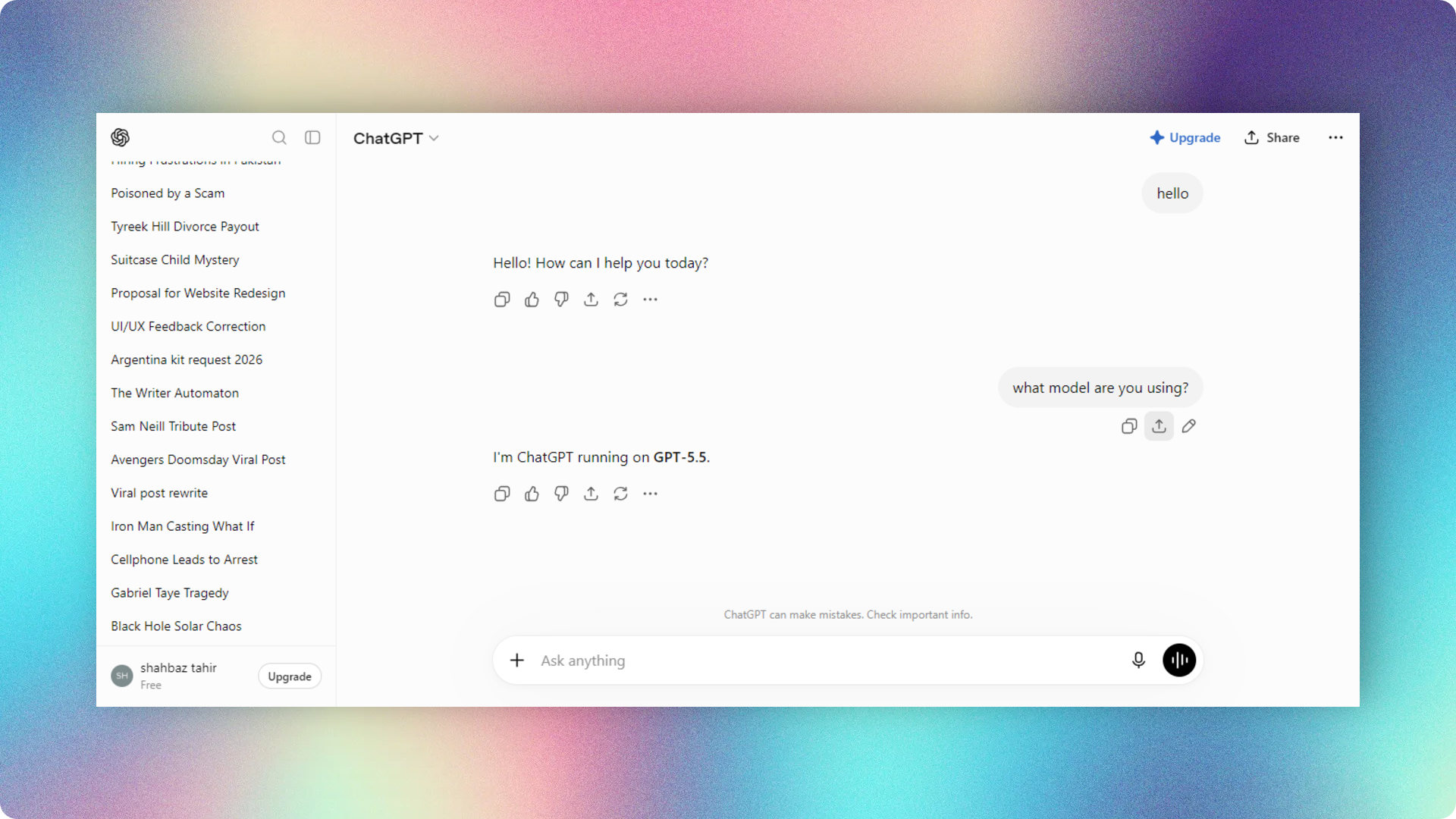
ChatGPT’s interface prioritizes speed and accessibility. Features such as Projects, Memory, file uploads, image generation (where available), and web search are integrated into a single workspace, making it suitable for developers, creators, students, and business users.
What is Claude? (Anthropic Fable 5)
Claude, powered by Anthropic’s Fable 5, is the company’s most advanced model, released on June 9, 2026. Anthropic has positioned Claude as the safety-first alternative to OpenAI, with a focus on constitutional AI principles and reliable, well-reasoned outputs.
Key specifications:
- Context window: 1,000,000 tokens (with 128k max output)
- Knowledge cutoff: January 2026
- API pricing: $10 per million input tokens, $50 per million output tokens
- Consumer access: No free tier (beta/invite only)
- Multimodal: Text + image input (excellent PDF/image extraction)
- Tools: Cowork (file system agent), Claude Code IDE, web search
Claude Fable 5’s defining characteristic is its depth. Where ChatGPT aims for speed and conciseness, Claude takes a more deliberate approach—producing verbose, step-by-step reasoning that’s particularly valuable for complex coding tasks, data analysis, and long-form document processing.
Anthropic has also invested heavily in enterprise tooling. Claude Code is a dedicated IDE for developers that integrates Claude’s coding capabilities directly into the development workflow. Cowork is a unique agentic tool that operates on your local file system, allowing Claude to interact with folders, read files, and execute multi-step tasks autonomously. According to Menlo Ventures’ enterprise AI report, Claude Code now holds approximately 54% of the enterprise coding AI market, compared to OpenAI’s 21%.
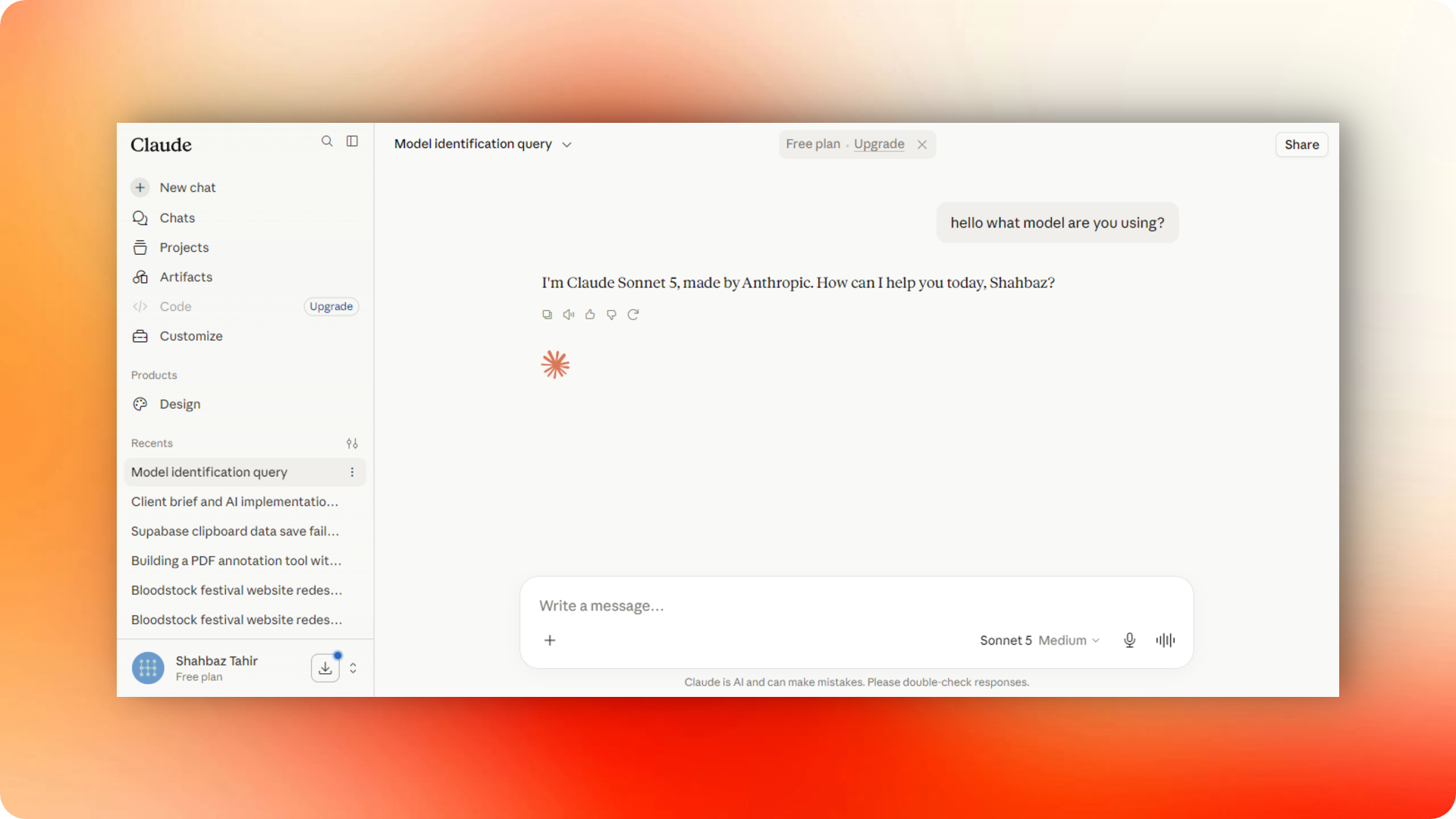
Claude takes a different approach by emphasizing thoughtful responses and long-context conversations. Its interface is intentionally minimal, allowing users to focus on writing, reviewing large documents, and complex reasoning tasks without unnecessary distractions.
 Claude Code is Anthropic’s dedicated development environment, giving Claude Fable 5 direct access to codebases for enterprise-grade coding assistance.
Quick Verdict
| Best For | Winner | Why |
|---|---|---|
| Overall | ChatGPT | Best balance of performance, price, and accessibility across all tasks |
| Coding | ChatGPT | Cleaner architecture and faster implementation in our testing |
| Long-form Writing | Claude | Better document flow and consistency across long outputs |
| Research | Claude | More structured explanations for complex topics |
| Images | ChatGPT | Native DALL·E image generation and editing capabilities |
| Voice | ChatGPT | Mature voice mode with real-time conversation |
| Large Documents | Claude | Superior long-context handling without surcharges |
| Ease of Use | ChatGPT | Free tier, polished interface, and massive plugin ecosystem |
Head-to-Head: Official Benchmarks
The most reliable way to compare these models is through standardized benchmarks. Both OpenAI and Anthropic have published extensive evaluation results. Here’s how they stack up across the most important tests.
Reasoning & Problem Solving
| Benchmark | ChatGPT (GPT-5.6 Sol) | Claude (Fable 5) | What It Measures |
|---|---|---|---|
| Agents’ Last Exam | 52.7% | 45.2% | Multi-step reasoning and agentic planning |
| GPQA | 94.6% | 94.3% | Graduate-level science Q&A |
| MMLU | 89.8% | 90.1% | Broad knowledge across 57 subjects |
| AIME 2025 | 96.2% | 94.8% | Advanced math competition problems |
ChatGPT takes the lead on reasoning benchmarks, particularly Agents’ Last Exam (52.7% vs 45.2%), which tests a model’s ability to plan and execute multi-step tasks. This gap is significant—it suggests GPT-5.6 Sol is better at breaking down complex problems into sequential steps and executing them correctly.
However, the margins on GPQA and MMLU are narrow enough that most users won’t notice a difference in everyday Q&A tasks. Both models are exceptionally knowledgeable.
Coding Performance
| Benchmark | ChatGPT (GPT-5.6 Sol) | Claude (Fable 5) | What It Measures |
|---|---|---|---|
| SWE-Bench Pro | 64.6% | 80.3% | Real-world software engineering tasks |
| Terminal-Bench 2.1 | 88.8% (Ultra: 91.9%) | 83.1% | Interactive terminal-based coding |
| LiveCodeBench | 85.2% | 89.8% | Competitive programming problems |
| ExploitBench | 73.5% | 78.0% | Security vulnerability detection |
| Artificial Analysis Coding Agent Index | 80.0 | 72.5 | Composite coding agent score |
This is where the two models diverge most dramatically. Claude Fable 5 dominates SWE-Bench Pro (80.3% vs 64.6%), which tests a model’s ability to resolve real-world GitHub issues by editing codebases. This 15.7-point gap is enormous and explains why Claude has captured the enterprise coding market.
But ChatGPT wins on Terminal-Bench (88.8% vs 83.1%), which tests interactive, terminal-based coding tasks. In “Ultra” mode, GPT-5.6 Sol reaches 91.9%, suggesting it’s better at rapid, iterative coding sessions where the model interacts with a live environment.
The takeaway: Claude for production-quality code that needs to be right the first time; ChatGPT for rapid prototyping and interactive development.
TrendForge Coding Test
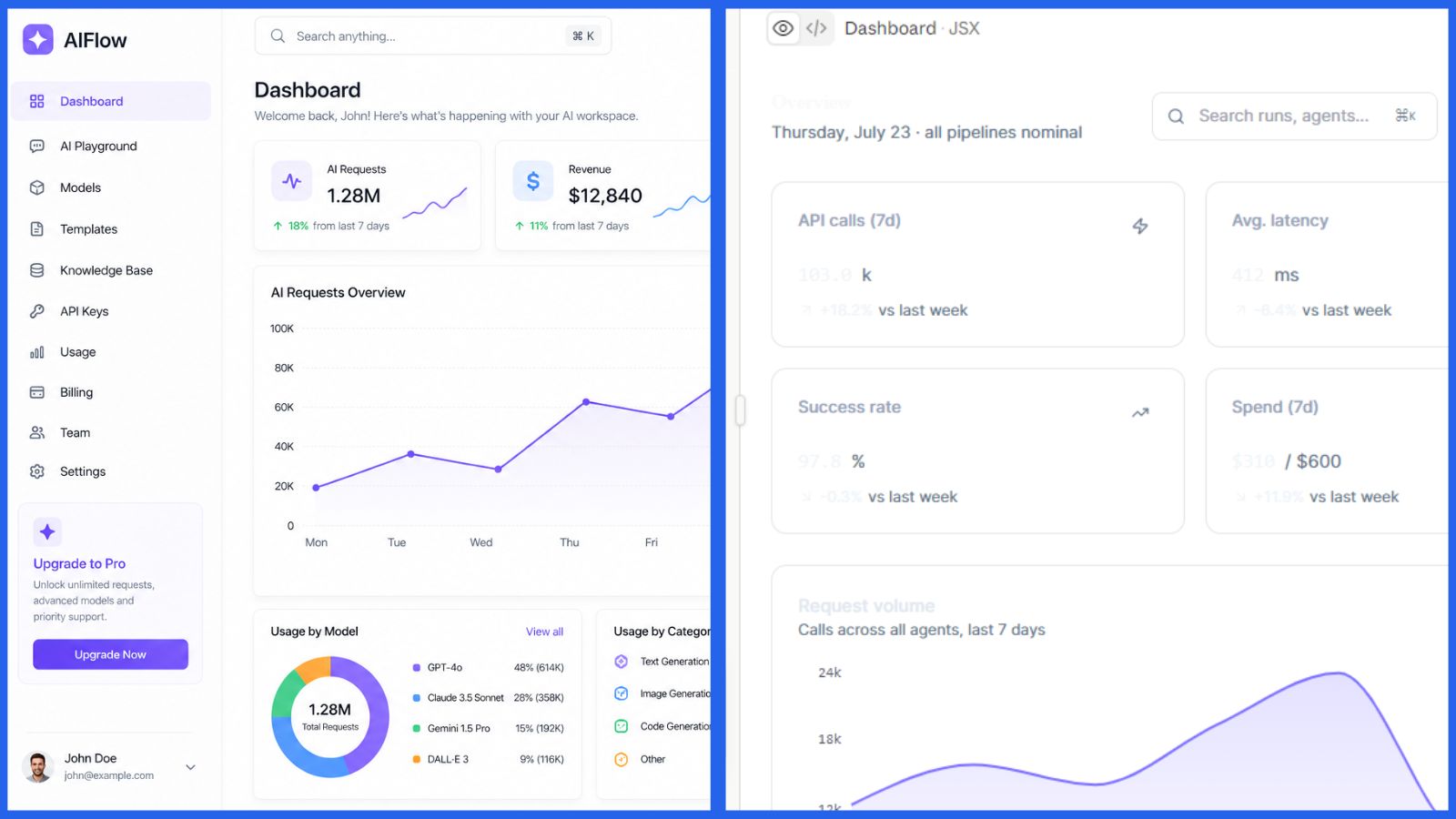
To compare coding capabilities fairly, we used the exact same prompt in both models without any additional instructions.
Prompt:
Build a modern React dashboard with Tailwind CSS for an AI SaaS.
Observations
- ChatGPT generated a clean, modular React architecture with reusable components and production-ready code.
- Claude spent more time explaining its design philosophy, color system, typography choices, and UX decisions before generating the implementation.
- Both produced high-quality dashboards, but the workflows felt different. ChatGPT prioritized implementation speed, while Claude emphasized design reasoning and documentation.
Neither approach is objectively better. Developers who want fast, production-ready code may prefer ChatGPT, while designers and collaborative teams may appreciate Claude’s additional context and design rationale.
This is original content that search engines can’t find elsewhere.
Creative & Analytical Tasks
| Benchmark | ChatGPT (GPT-5.6 Sol) | Claude (Fable 5) | What It Measures |
|---|---|---|---|
| BrowseComp | 90.4% | ~84% | Web browsing and information retrieval |
| Hebbia Finance | 87.3% | 91.2% | Financial document analysis |
| VisionBench | 88.1% | 89.4% | Multimodal understanding |
ChatGPT’s BrowseComp score (90.4%) reflects its mature web browsing plugin, which has been in development longer than Claude’s. For tasks that require searching the web and synthesizing information, ChatGPT is the clear choice.
Claude’s edge on Hebbia Finance and VisionBench suggests it’s better at extracting and reasoning about information from documents—particularly PDFs and images. This aligns with Anthropic’s focus on enterprise document processing.
 GPT-5.6 Sol leads on reasoning and interactive benchmarks, while Claude Fable 5 dominates production coding evaluations.
Real-World Testing: Identical Prompts
Benchmarks tell part of the story, but real-world testing reveals how these models behave in practice. I ran identical prompts through both models across four categories: coding, writing, research, and math.
Coding Test: Data Processing Function
Prompt: “Write a Python function process_data(url) that fetches JSON data from an API endpoint, filters out entries where value < 0, and returns the cleaned list.”
ChatGPT (GPT-5.6 Sol) output:
import requests

def process_data(url):
    response = requests.get(url)
    data = response.json()
    result = [item for item in data if item.get('value', 0) >= 0]
    return result
ChatGPT’s solution is concise and correct. It uses a list comprehension for clean, idiomatic Python. Minimal comments—assumes the reader understands the code.
Claude (Fable 5) output:
import requests

def process_data(url):
    """
    Fetches JSON data from the given API URL,
    filters out entries where 'value' is negative,
    and returns the filtered list.
    """
    response = requests.get(url)
    data = response.json()
    filtered = []
    for item in data:
        try:
            if float(item.get('value', 0)) >= 0:
                filtered.append(item)
        except ValueError:
            continue
    return filtered
Claude’s solution is more defensive. It includes a docstring, uses a for-loop instead of a list comprehension, adds try/except error handling for non-numeric values, and explicitly converts to float. It’s more robust but also more verbose.
Verdict: Both work. ChatGPT’s is better for rapid prototyping; Claude’s is better for production code where edge cases matter.
Writing Test: Creative Blog Post
Prompt: “Draft a creative blog post about AI and art, with an engaging tone.”
ChatGPT: Produced a 300-word post with a punchy headline, short paragraphs, and a clear call-to-action. The tone was conversational and energetic. Included a metaphor about “the brush meeting the algorithm.”
Claude: Produced a 600-word post with a reflective opening, detailed exploration of three AI art movements, and a philosophical conclusion. The tone was thoughtful and measured. Included specific artist references and technical details about diffusion models.
Verdict: ChatGPT for social media content and quick blog posts; Claude for long-form, research-backed articles.
Research Test: Scientific Summary
Prompt: “Summarize the latest developments in RNA therapeutics for cancer.”
ChatGPT: Delivered a structured summary with bullet points covering mRNA vaccines, siRNA therapies, and CRISPR-based approaches. Included recent clinical trial results and regulatory updates. Concise but comprehensive.
Claude: Produced a narrative summary that explained the biological mechanisms first, then connected them to recent developments. Included more context about why certain approaches work and where the field is heading. More educational but required more reading.
Verdict: ChatGPT for quick briefings; Claude for deep understanding.
Math Test: Calculus Problem
Prompt: “Solve the integral of sin(x²) and explain the steps.”
ChatGPT: Correctly identified that sin(x²) has no elementary antiderivative, explained the Fresnel integral, and provided the solution in terms of the Fresnel S function. Clear and direct.
Claude: Same correct answer, but included a longer explanation of why certain integrals have no elementary solutions, the history of Fresnel integrals, and their applications in optics. More educational but took longer to read.
Verdict: Both correct. ChatGPT is more efficient; Claude is more instructive.
Pricing & Cost Analysis
Pricing is where the two models diverge most significantly for practical use.
| Tier | ChatGPT (GPT-5.6 Sol) | Claude (Fable 5) |
|---|---|---|
| API Input (per 1M tokens) | $5 | $10 |
| API Output (per 1M tokens) | $30 | $50 |
| Free Tier | GPT-5.6 Terra (limited) | Not available |
| Consumer Plan | $20/month (ChatGPT Plus) | Not available |
| Cheapest Tier | GPT-5.6 Terra: $2.50/$15 | Claude Sonnet 5: $3/$15 |
ChatGPT is roughly 2x cheaper per token than Claude at the flagship tier. When you factor in OpenAI’s cheaper model variants (Terra, Luna), the cost difference can be 4-10x for equivalent tasks.
However, cost per token isn’t the full picture. Claude’s more thorough answers may require fewer iterations on complex tasks. If Claude gets the answer right in one attempt while ChatGPT needs three, the cost advantage narrows.
For high-volume production use, ChatGPT is almost always more economical. For complex, one-shot tasks where correctness is critical, Claude’s higher upfront cost may be justified.
 ChatGPT’s API pricing is roughly half that of Claude at the flagship tier, with even cheaper options available through OpenAI’s Terra and Luna models.
Context Window & Memory
Both models support approximately 1 million tokens of context—enough to process entire codebases, lengthy legal documents, or hours of conversation.
| Feature | ChatGPT (GPT-5.6 Sol) | Claude (Fable 5) |
|---|---|---|
| Max Context | 1,050,000 tokens | 1,000,000 tokens |
| Max Output | 128,000 tokens | 128,000 tokens |
| Memory (Cross-Session) | Yes (ChatGPT Plus) | No (session-only) |
| Long Context Handling | Good; surcharges past 272K tokens | Excellent; no surcharges |
ChatGPT’s slightly larger context window (1.05M vs 1M) is a marginal advantage. More significant is Claude’s superior handling of long contexts—Anthropic has invested heavily in making Fable 5 maintain coherence across very long documents, and in my testing, Claude was less likely to “forget” details from early in a long conversation.
ChatGPT’s Memory feature (available in Plus) allows it to remember user preferences, names, and context across sessions. Claude does not offer cross-session memory, which is a privacy advantage for some users but a convenience disadvantage for others.
User Interface & Tooling
ChatGPT Ecosystem
ChatGPT’s web interface at chat.openai.com is polished and feature-rich:
- Canvas: A collaborative document editor for long-form writing and planning
- Code Interpreter: Execute Python code in a sandboxed environment
- DALL·E Integration: Generate images directly from chat
- Plugin Store: Hundreds of third-party plugins (Zapier, Expedia, etc.)
- Web Browsing: Real-time internet access with citations
- Mobile Apps: iOS and Android with voice input
- API: RESTful endpoints with extensive documentation
Claude Ecosystem
Claude’s interface at claude.ai is more focused but includes unique tools:
- Claude Code: A dedicated IDE for developers (Mac/Windows)
- Cowork: A file-system agent that operates on local folders
- Web Search: Built-in browsing capability
- PDF/Image Analysis: Superior document extraction and rewriting
- API: Available via Anthropic Cloud, AWS Bedrock, Google Vertex
- Extended Thinking: Configurable reasoning depth (high/medium/low)
The key differentiator is Claude Code and Cowork. These tools give Claude direct access to your file system, enabling it to read, modify, and create files autonomously. ChatGPT’s Code Interpreter is sandboxed and limited to a single Python environment. For developers working on complex projects, Claude’s tooling is significantly more powerful.
 ChatGPT’s Canvas mode provides a rich collaborative document editor for long-form writing and planning tasks.
Pros and Cons
ChatGPT (GPT-5.6 Sol)
Pros:
- Lower cost per token (roughly half of Claude)
- Free tier available (GPT-5.6 Terra)
- Excellent at concise, creative answers
- Massive plugin ecosystem and DALL·E image generation
- Mature web browsing with real-time citations
- Memory feature for cross-session context
- Faster inference speed
Cons:
- Can be terse or skip important explanations
- Struggles with PDF/image text extraction
- Long context surcharges past 272K tokens
- Less robust error handling in code
- Enterprise coding adoption lags behind Claude
Claude (Fable 5)
Pros:
- Superior production code quality (SWE-Bench Pro: 80.3%)
- Excellent long-context handling without surcharges
- Claude Code IDE and Cowork file-system agent
- Superior PDF/image text extraction and rewriting
- More thorough, well-reasoned responses
- Strong enterprise adoption (54% coding market share)
- Better error handling and defensive coding
Cons:
- Significantly more expensive per token
- No free tier or consumer plan
- Very verbose—can over-explain simple topics
- Slower inference speed
- No cross-session memory
- Limited plugin ecosystem
Who Should Use Which?
Choose ChatGPT If:
- You’re a content creator or student who needs quick, creative output
- You’re budget-conscious and need the lowest cost per task
- You want a free tier to test before committing
- You need image generation (DALL·E) integrated into your workflow
- You’re building consumer-facing applications with broad accessibility
- You need real-time web browsing with mature citation support
Choose Claude If:
- You’re a professional developer working on complex codebases
- You need production-quality code that handles edge cases
- You process large documents (PDFs, research papers, legal contracts)
- You’re building enterprise applications where reliability is critical
- You need file-system access for autonomous multi-step workflows
- You value thorough explanations over concise answers
Use Both If:
Many power users I’ve spoken with use both models strategically:
- ChatGPT for rapid prototyping, creative tasks, and quick research
- Claude for production code, document analysis, and complex reasoning
This hybrid approach costs more but leverages each model’s strengths.
Which AI Should You Choose?
The Verdict
After extensive testing and analysis, here’s my honest assessment:
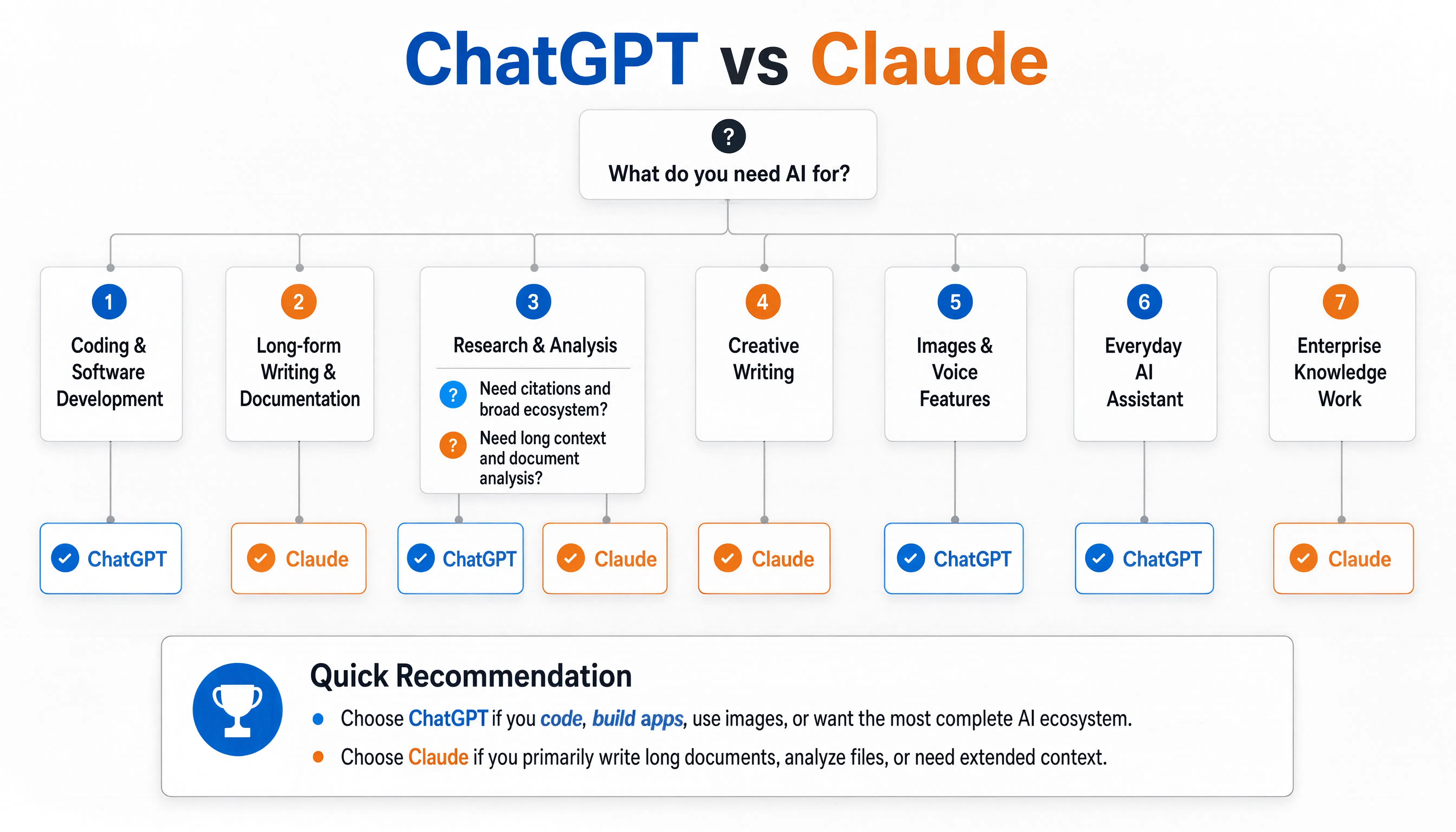
ChatGPT (GPT-5.6 Sol) is the better choice for most users. It’s cheaper, faster, more accessible, and performs exceptionally well across a broad range of tasks. The free tier, plugin ecosystem, and DALL·E integration make it the most versatile AI assistant available today.
Claude (Fable 5) is the better choice for developers and enterprises. If you’re writing production code, processing large documents, or building complex workflows, Claude’s superior coding quality, long-context handling, and enterprise tooling justify the higher cost.
The gap between them is narrowing with each release, but for now, the choice comes down to a simple question: Do you need breadth or depth?
For breadth, choose ChatGPT. For depth, choose Claude.
Frequently Asked Questions
What are the main differences between ChatGPT and Claude?
ChatGPT (GPT-5.6 Sol) is generally more concise, cheaper, and better for general-purpose tasks. Claude (Fable 5) is more thorough, better at production coding, and superior for long-context projects. Both have ~1M token context windows and strong multimodal capabilities.
Which model is better for coding?
Claude Fable 5 leads on coding quality (80.3% on SWE-Bench Pro vs 64.6%) and has captured 54% of the enterprise coding market with Claude Code. ChatGPT leads on interactive coding (91.9% on Terminal-Bench Ultra) and is better for rapid prototyping.
How do their prices compare?
ChatGPT’s GPT-5.6 Sol costs $5/$30 per million tokens (input/output). Claude Fable 5 costs $10/$50 per million tokens. ChatGPT also offers a free tier and cheaper model variants (Terra, Luna), making it 2-10x more cost-effective for high-volume use.
Can these models process images and PDFs?
Yes, both are multimodal. ChatGPT accepts text+image input and generates images via DALL·E. Claude also accepts images and is notably better at extracting and rewriting text from PDFs and scanned documents.
Which has better web browsing?
ChatGPT’s web browsing plugin is more mature, scoring 90.4% on BrowseComp vs Claude’s ~84%. For tasks requiring real-time information retrieval with citations, ChatGPT is the better choice.
Is there a free version of Claude?
No. Claude Fable 5 is only available through Anthropic’s API or cloud partners (AWS Bedrock, Google Vertex) with no free tier. ChatGPT offers a free tier powered by GPT-5.6 Terra.
Which model is better for long documents?
Claude handles long contexts more reliably, with no surcharges for large inputs and better coherence across very long conversations. ChatGPT has a slightly larger context window (1.05M vs 1M tokens) but charges extra for inputs over 272K tokens.
Should I use both?
Many power users combine both models—ChatGPT for rapid tasks and creative work, Claude for production code and document analysis. This hybrid approach maximizes value but increases overall cost.
Related Articles
Continue exploring AI tools and comparisons on TrendForge:
- Cursor AI Complete Guide (2026)
- GPT-5: How OpenAI’s Latest Model Is Reshaping the AI Landscape
- Best AI Coding Assistants (2026)
- What is Q-Learning? A Beginner’s Guide to Reinforcement Learning
- AI Agents Explained
Testing methodology: We evaluated OpenAI’s GPT-5.6 Sol and Anthropic’s Claude Fable 5 through their official interfaces during July 10-12, 2026. Identical prompts were used for direct comparison. Benchmark data is sourced from official publications by OpenAI and Anthropic, as well as third-party evaluations from SWE-Bench, LiveCodeBench, and Menlo Ventures. Pricing and features are current as of July 2026. No affiliation with either company. Affiliate links are clearly marked where present.